Demystifying Linux Network Fastpath: Software & Hardware Flow Offloading on OpenWRT
Overcoming kernel netfilter forwarding bottlenecks to achieve line-rate gigabit throughput on resource-constrained embedded router hardware.

When transitioning home lab infrastructure or high-bandwidth residential uplinks to gigabit tiers (such as TM UniFi Turbo 800 Mbps), embedded routers frequently encounter a severe bottleneck: CPU saturation during Layer 3 packet forwarding and Network Address Translation (NAT).
Stock vendor firmwares frequently utilise proprietary hardware NAT acceleration shortcuts to sustain gigabit routing on modest System-on-Chip (SoC) architectures. Replacing vendor firmware with OpenWRT yields vast security, auditability, and configuration gains, but traditionally forced every packet through the full Linux kernel netfilter stack, collapsing throughput on sub-gigahertz single-core MIPS CPUs to ~250–300 Mbps.
The introduction of Flow Offloading in OpenWRT 19.07 fundamentally changed this equation by introducing a fastpath that bypasses redundant kernel processing for established flows.
The Linux Netfilter Bottleneck
In a conventional Linux routing environment, every single ingress packet must traverse the full evaluation pipeline:
- Ingress network driver ring buffers and socket buffers (
sk_buff). - Netfilter
PREROUTINGchain evaluation. - Connection tracking (
conntrack) table lookup and state inspection. - Routing decision (FIB lookup).
- Netfilter
FORWARDchain rule traversal. POSTROUTINGevaluation and Source NAT (SNAT/Masquerade) rewriting.- Egress transmission.
For long-lived, high-throughput bidirectional streams (such as multi-hundred-megabit file transfers, steam downloads, or raw speed tests), running every 1500-byte MTU frame through this entire gamut consumes excessive CPU instruction cycles. On an Atheros QCA9558 single-core MIPS processor clocked at 720 MHz (the backbone of the TP-Link Archer C7 v2), the CPU hits 100% software interrupt (si) saturation well before reaching line rate.

Architectural Mechanism: The Flowtable Fastpath
Flow offloading leverages nftables flowtables in the Linux kernel. When a TCP or UDP bidirectional flow passes through connection tracking and establishes its initial three-way handshake, the kernel registers the flow into an in-memory hardware or software flowtable.
Subsequent packets belonging to this active tuple bypass:
- The
iptables/nftablesrule traversal. - Repeated connection tracking state queries.
- Repeated route cache lookups.
Instead, the network driver reads the destination MAC, source MAC, and L3 addresses directly from the flowtable entry, updates the checksums, and dispatches the packet immediately to the egress interface queue.
Software vs. Hardware Offloading: Hardware Architecture Realities
OpenWRT offers two offloading modes:
- Software Flow Offloading: Implemented in pure Linux kernel code. It runs on the CPU but slashes per-packet instruction overhead. This operates across virtually all network chipsets.
- Hardware Flow Offloading: Offloads flow forwarding directly to hardware packet acceleration engines inside the Ethernet switch silicon (common in MediaTek MT7621/MT7622 and Qualcomm Atheros PPE chipsets).
[!NOTE] Hardware flow offloading requires explicit silicon driver hooks. On devices like the TP-Link Archer C7 v2 (QCA9558 MIPS), the integrated switch core lacks open-source hardware flow acceleration driver support. As such, software flow offloading must be used exclusively. Attempting to enable hardware offload on unsupported chipsets is either silently ignored or may cause driver instability.
Implementation & Tuning
Step 1: Upgrading & Package Verification
Flow offloading requires OpenWRT 19.07 or later with kmod-ipt-offload or kmod-nft-offload:
# Verify active kernel version
uname -r

# Verify flowtable kernel module availability
opkg update
opkg list-installed | grep -E "kmod-ipt-offload|kmod-nft-offload"
Step 2: Enabling the Fastpath
In the OpenWRT web interface (LuCI), navigate to Network > Firewall. Under General Settings, locate Routing/NAT Offloading:
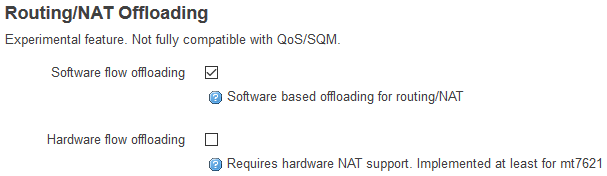
Alternatively, configure /etc/config/firewall directly via the CLI:
config defaults
    option flow_offloading '1'
    option flow_offloading_hw '0'
Commit the change and restart the firewall service:
uci commit firewall
/etc/init.d/firewall restart
Benchmark Results: 300 Mbps to 720+ Mbps
Before enabling software flow offloading on the 800 Mbps UniFi fibre connection, line throughput on the Archer C7 plateaued at 290–310 Mbps, with htop reporting 99–100% CPU utilisation in ksoftirqd.
Upon activating software flow offloading:
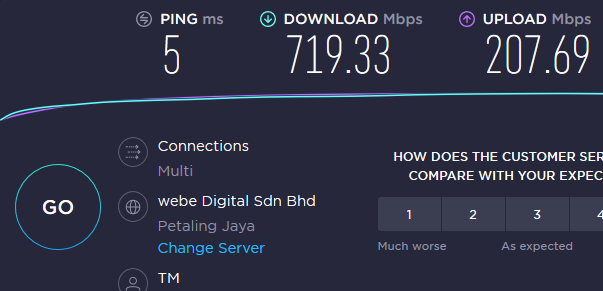
- Throughput: Jumped immediately to 719 Mbps downstream.
- CPU Overhead: dropped significantly, leaving headroom for concurrent DNS queries and administrative telemetry.
Architectural Trade-offs & Production Considerations
While flow offloading delivers a dramatic performance boost, engineering leaders must recognise its trade-offs:
- Incompatibility with Smart Queue Management (SQM):
Because packets bypass the standard kernel queuing disciplines (
qdisc), advanced Active Queue Management (such as CAKE orfq_codel) cannot intercept or schedule offloaded flows. If your uplink experiences significant bufferbloat, you must evaluate whether you prioritise raw gigabit throughput or deterministic latency guarantees under saturation. - Per-Packet Firewall Logging & Inspection:
Packets traversing the fastpath do not trigger per-packet
iptableslogging rules. Flow accounting and byte counters continue to synchronise periodically back to conntrack, but packet-level DPI or IDS/IPS hooks will not evaluate every intermediate packet. - Failover Behaviour: If an established flowtable connection drops or terminates (via TCP FIN/RST or timeout), the flow entry is evicted, and any new handshake naturally returns to the slowpath for security policy evaluation.